In 1976 a lecturer at the University of New South Wales ran off a course pack for his operating systems class. Inside were two volumes: the complete source listing of a working operating system, and a chapter-by-chapter commentary explaining what every part of it did. The Lions Commentary on Unix annotated the Sixth Edition kernel — roughly 9,000 lines including assembly — and it is the closest thing the discipline has ever produced to a full, readable exposition of a production operating system that people actually ran on real hardware. For the better part of two decades afterwards, it had no publisher, and the only way to get it was from someone who already had a copy.
That is the story most people know, usually in a garbled form: AT&T banned the book. AT&T did not ban the book. What happened is more interesting and more useful, because it is a clean, fifty-year-old worked example of something engineers keep rediscovering the hard way — licence terms are architecture. A clause in a distribution agreement decided what a generation of computer scientists were able to learn, which in turn decided which operating system they went on to build. No engineering decision in this story mattered nearly as much as the paperwork.
Disclosure: some links below are Amazon affiliate links. If you buy through them, I earn a small commission — at no extra cost to you — which helps keep this site running.
An Entire Operating System You Could Hold in Your Head
Start with the number, because everything else follows from it.
The Sixth Edition kernel is about 9,000 lines, assembly included. John Lions split his notes into two volumes — one a printed listing of that source with the lines numbered so they could be cited precisely, the other a commentary walking through it in reading order. A student could work through the whole thing over a single term and come out the other side having read all of it: the process table, fork and exec, the buffer cache, the file and inode tables, the trap and interrupt paths, the scheduler, the terminal driver. Not a subsystem. Not a simplified teaching model. The actual system, as shipped.
Nothing about that is available to an engineer today, and it is worth sitting with how strange it now sounds. There is no current operating system whose complete implementation a competent person can read in a term. There is no current browser like that, or database, or compiler. The default relationship between a working engineer and the systems underneath them is partial: you read the subsystem you need, trust the interface for the rest, and never form a picture of the whole.
Lions’ students formed a picture of the whole. That is the thing the book is famous for, and it is why the book survived being pushed out of print. People do not photocopy a textbook for twenty years because the prose is good.

The second-order effect is the one architects should care about. When a system is small enough to be read entirely, the questions people ask about it change. They stop asking “how do I call this?” and start asking “why is it shaped this way?” — and they start noticing the parts that are not defensible. Lions’ commentary is not devotional. It flags the places where the Sixth Edition is crude, where a routine is doing something expedient rather than something principled, where the implementation and the manual page disagree. Reading a whole system produces critics. Reading one subsystem produces users.
Why This Book Could Exist at All: The 1956 Consent Decree
Lions could print AT&T’s source code and hand it to undergraduates because of an antitrust settlement signed thirteen years before Unix existed.
The Department of Justice filed a Sherman Act complaint against AT&T and Western Electric in 1949. It settled in 1956 on terms that left the Bell System intact but barred AT&T from engaging in “any new business other than the provision of common carrier communications services” (Federal Judicial Center, The Breakup of “Ma Bell”). The practical consequence, once Unix appeared in 1969, was that the company holding it was foreclosed from the computer business.
Here is where nearly every retelling goes wrong, so be precise about it: this did not mean AT&T could not sell Unix. AT&T licensed Unix commercially throughout the 1970s — a Sixth Edition commercial licence is commonly reported at around US$20,000 by the late 1970s, against a nominal academic figure usually cited near US$150 for the cost of the tape. Unix was never free. What the decree prevented was running it as a supported product line, and the artifact of that posture is AT&T’s own stated policy, delivered to users at a Winter USENIX/UniForum meeting:
“No advertising, no support, no bug fixes, payment in advance.”
That is not the language of a company that cannot sell something. It is the language of a company selling something it is not allowed to treat as a business. And the side effect was decisive: if you were not going to get support, you were going to get source, because source was the only way anyone could keep the thing running. Universities got tapes, cheaply, with the code on them — and critically, the Sixth Edition licence permitted classroom use of that source.
That clause is the entire reason the Lions Commentary on Unix exists.

June 1979: The Classroom Clause Disappears
AT&T announced the Seventh Edition at USENIX in June 1979. The new licence terms no longer permitted classroom use of the source, and AT&T restricted the copying and circulation of commentaries on it. Nobody sued John Lions. No court enjoined anything. A term changed in a distribution agreement, and a book that had been perfectly legal teaching material a year earlier became material that could not be legally taught from.
Call that suppression if you like — the effect was suppression — but understand the mechanism, because the mechanism is the transferable part. The licence was the enforcement. There was no need for a lawsuit, a takedown, or a single letter to a lecturer. Changing the terms under which the artifact was distributed was sufficient to remove it from every syllabus in the world simultaneously.
The follow-on effects are traceable and they are large:
- The teaching gap opened immediately. For the next decade there was no legally usable, complete, readable operating system source for a university course.
- Andrew Tanenbaum wrote Minix to fill it, releasing it in 1987 alongside his textbook Operating Systems: Design and Implementation. Minix shipped source — but the copyright sat with the publisher, and users could not redistribute modified versions, only diffs that each recipient applied and rebuilt locally.
- That restriction is repeatedly cited both as a motive for Linus Torvalds writing his own kernel in 1991 and for his subsequent choice of the GPL, which he made effective for Linux on 1 February 1992.
Three consecutive licensing decisions, three consecutive workarounds. AT&T restricted classroom source; the field produced Minix. Minix restricted redistribution of modified versions; the field produced Linux. At no point did restricting access preserve the value of the restricted thing. It routed the community around it, and the route it took became the new default.

Twenty Years of Bootlegs
What happened to the book itself is the part everyone remembers.
It circulated. Photocopies were made from photocopies, which were made from photocopies. A department in one country would receive a copy from a colleague in another, run off a dozen more, and pass them on. By common repute among the people who lived through it, the Lions Commentary became the most-copied book in the history of computing — a claim nobody has ever measured and nobody who was there disputes.
The physical evidence is the best image in this whole story. A fifth- or sixth-generation photocopy of a numbered source listing is barely a document. The blacks bloom, thin strokes drop out, the page edges go dark, and the code — which is the entire point, and which depends on characters like |, &, * and ; being distinguishable — degrades toward mush. People kept copying it anyway. They kept copying it for twenty years, through the arrival of System V, the Unix wars, and the entire commercial Unix industry, because there was no legal alternative and the material was worth the degradation.
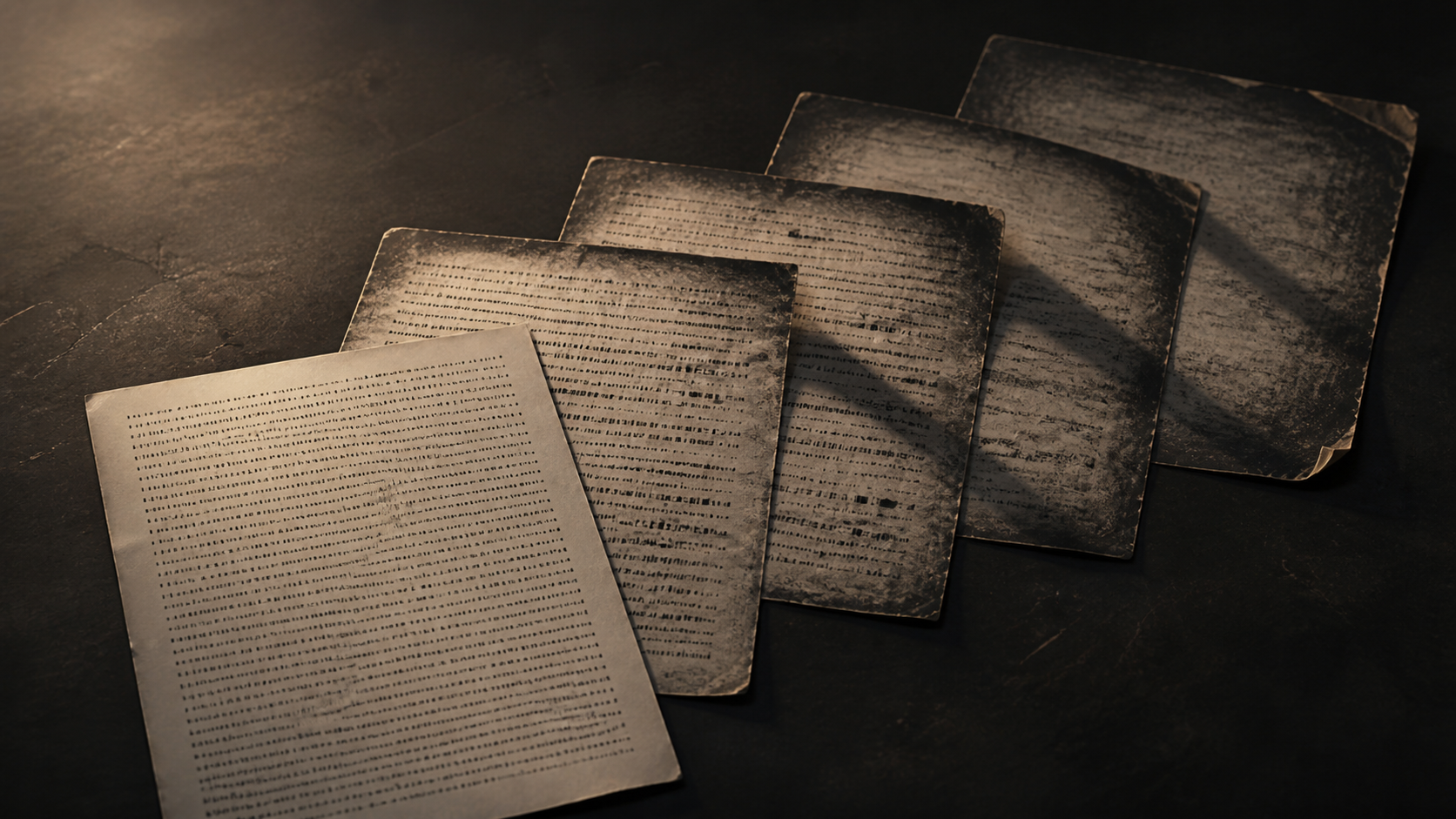
That is a measurement of demand, taken under adverse conditions. It is also the cleanest available refutation of the idea that closing source access protects an asset’s value. The value did not go away. It went underground, unpaid, uncontrolled, and unmonetised, and AT&T got nothing for any of it.
1996: The Book Becomes Legal
Peer-to-Peer Communications reissued the commentary in 1996 as a single volume of roughly 260 pages (ISBN 1-57398-013-7), bringing both of Lions’ original volumes back into print together (publisher record; ACM Digital Library record). It happened because the Santa Cruz Operation — which had bought the Unix assets from Novell in 1995 — authorised release of the then-twenty-year-old Sixth Edition code that the book reproduces.
The reissue added new commentary from people with standing to give it: Dennis Ritchie, Ken Thompson, Peter Salus, Michael Tilson, Peter Collinson, Marshall Rose, Mike O’Dell, Berny Goodheart and Peter Reintjes. That apparatus is the reason the 1996 edition is worth owning rather than merely reading — it is the annotated source plus a retrospective from the people who wrote the thing being annotated.
One naming precision, because this trips up almost every account: the Santa Cruz Operation that authorised the 1996 release is not the company that later sued IBM. Santa Cruz’s server and Unix divisions were bought by Caldera Systems in a deal that closed in May 2001, making the merged firm Caldera International; the original Santa Cruz Operation renamed itself Tarantella, Inc.; and Caldera International renamed itself The SCO Group in August 2002. Two different companies, one recycled name.
24 January 2002: The Source Goes Free, Permanently
Six years after the reissue, the code itself was freed.
On 24 January 2002, Caldera International released Research Unix Editions 1 through 7 (PDP-11) and 32V (VAX) under a BSD-style licence (the licence letter; TUHS record of the free licences). System III and System V were explicitly excluded. That grant is why the entire early Unix corpus — including the exact 9,000 lines Lions annotated — is legally readable, redistributable, and modifiable today, and it is why the Unix Heritage Society archive can host it in the open.
The timing has teeth. Caldera International renamed itself The SCO Group seven months later, and in March 2003 that company began the litigation campaign over Unix code that ran until a 2021 settlement. The same corporate lineage freed the historic source about a year before it started suing over the modern source. Nothing in this story is a morality tale; it is a demonstration that ownership of a codebase and strategy toward a codebase are separate variables that can flip fast.
| Date | Event | What it did to the book |
|---|---|---|
| 1956 | AT&T consent decree bars “any new business other than the provision of common carrier communications services” | No supported product line → Unix goes to universities cheaply, with source |
| 1975 | Sixth Edition ships; its licence permits classroom use of the source | Makes the course pack legally possible |
| 1976–77 | Lions writes the two-volume commentary at UNSW | ~9,000 lines of a real kernel, annotated, readable in a term |
| June 1979 | AT&T announces the Seventh Edition at USENIX; the new licence excludes classroom use and restricts commentaries | The book can no longer be legally taught from |
| Aug 1982 | The Modification of Final Judgment frees AT&T to enter computing (System V Release 1 ships January 1983) | Licence prices ratchet up; source access closes further |
| 1979–1996 | Photocopies pass hand to hand across the world | Generation-loss samizdat; most-copied book in the field, by common repute |
| 1987 | Tanenbaum releases Minix with Operating Systems: Design and Implementation | A teaching OS built to fill the gap the V7 licence created |
| 1996 | Peer-to-Peer reissue (ISBN 1-57398-013-7) after the Santa Cruz Operation authorises the 20-year-old V6 code | The book is purchasable, legally, for the first time |
| Dec 1998 | John Lions dies | He saw the book in print; not the source freed |
| 24 Jan 2002 | Caldera International releases Editions 1–7 and 32V under a BSD-style licence | The annotated source becomes permanently free |
| 2003–2021 | The same lineage, renamed The SCO Group, litigates over Unix code | The freed historic source predates the suits by a year |

John Lions Died in December 1998
He lived to see the book in print. He did not live to see the code it annotated become free.
That is worth stating plainly rather than dressing up. A teacher wrote the best available explanation of how an operating system worked, was prevented by a licence clause from teaching it, watched it circulate for two decades as contraband, got it published two years before he died, and missed the permanent release of the underlying source by a little over three years. The vindication arrived; he was not there for it.
What Is Actually Free Today — and What Is Not
This is the part where accuracy matters most, because the licensing here is split, and conflating the two halves is the standard mistake.
The Sixth Edition source code — the listing volume’s subject matter — is unambiguously free under the January 2002 Caldera licence, distributed by TUHS. You may read it, copy it, port it, and publish your own commentary on it.
The commentary text is a different artifact with a different owner. It is a separately copyrighted 1996 Peer-to-Peer Communications publication. PDFs of it circulate widely on personal sites, university pages and code-hosting platforms, and the licence status of those copies is unverified. Nobody should tell you that downloading one is legal, and this article is not telling you that. If you want the commentary, the honest routes are a used print copy or a library.
| Artifact | Status | Where |
|---|---|---|
| Research Unix V1–V7 and 32V source, including the V6 kernel Lions annotated | Free — BSD-style Caldera licence, 24 Jan 2002. System III and System V excluded | tuhs.org |
| The commentary text (1996 Peer-to-Peer edition) | Separately copyrighted. Circulating PDFs: licence status unverified — do not assume authorisation | Print; used market |
| Internet Archive scan of the original 1977 UNSW notes | Bibliographic record of the original’s form; no licence claim is made here | archive.org |
| Peter Salus, A Quarter Century of UNIX | Out of print at the publisher; author-authorised scan distributed by TUHS | TUHS |
| POSIX.1-2024 / Base Specifications Issue 8 | Free to read in full; the current text of “Unix as an interface” | pubs.opengroup.org |
| The UNIX-HATERS Handbook | Free PDF since 2003; the canonical edition | web.mit.edu/~simsong/www/ugh.pdf |
| The Art of Unix Programming | Free full text | catb.org/~esr/writings/taoup/ |
| Operating Systems: Three Easy Pieces | Free PDF, permanently | ostep.org |
The pattern in that table holds across every systems subject worth a reading list: the primary sources are free and the secondary commentary costs money. The specification, the source and the man pages are normative and cost nothing; the books explaining them are interpretations and cost $60–$90. A team reading list that opens with a hardback and never links pubs.opengroup.org has the dependency backwards.
The Honest Question: Was It Unix, or Was It 1975?
Here is the uncomfortable part, and this article is not going to resolve it for you.
The romantic reading of the Lions story is that early Unix was designed for comprehensibility — that Thompson and Ritchie chose small, chose mechanism over policy, chose a handful of orthogonal primitives, and that the 9,000-line kernel is the measurable result of taste. There is real evidence for this. The authors kept saying so. The Sixth Edition does far more than its size suggests, and the abstractions it introduced are still load-bearing fifty years later.
The deflationary reading is that a PDP-11 gave you no choice. The machine’s address space set a hard ceiling on how large a kernel could be, and every operating system of that era was correspondingly small. Under that reading, comprehensibility was not a design value at all — it was a hardware constraint that later got promoted to a philosophy, retroactively, by people who admired the result.
| Dimension | Sixth Edition (1975) | A current mainstream kernel |
|---|---|---|
| Kernel source size | ~9,000 lines including assembly | Tens of millions of lines across all drivers and architectures |
| Hardware support | One machine family | Dozens of architectures, thousands of devices |
| Networking | None in the base kernel | Full stack, multiple protocol families |
| Concurrency | Single processor, no kernel threads | SMP, preemption, kernel threads, RCU |
| Memory management | Swapping; no demand paging | Demand paging, NUMA, huge pages, page-cache machinery |
| Security model | root / non-root, plus setuid | Namespaces, capabilities, seccomp, cgroups, LSMs |
| Filesystems | One | Dozens, plus stacking and network filesystems |
| Readable in full by one person | Yes, in a term | No |
Look honestly at the right-hand column. Almost none of it is bloat. Networking is not optional. SMP is not optional. Demand paging is not optional. A kernel that supports thousands of devices across dozens of architectures is necessarily larger than one that supports a PDP-11 — and once it is that much larger, no amount of taste makes it readable whole.
So the question stands, and it is worth carrying around: was comprehensibility a property of early Unix, or just a property of early software? If it is the former, then modern systems are failing at something they could fix. If it is the latter, then the Lions Commentary is not a standard we fell short of — it is a snapshot of a moment that could not have lasted, and the nostalgia around it is misdirected.

The useful synthesis is probably this: comprehensibility was never a property of systems, it is a property of layers. Nobody reads Linux whole, and nobody reads Chromium whole either — but a competent engineer can still read one subsystem whole, with a guide, and get the same effect Lions’ students got. The modern equivalent of the Lions Commentary is not a book covering everything. It is a bounded, annotated tour of one subsystem you can finish. That is an achievable target, and most codebases do not offer one, which is a choice their maintainers made rather than a law of nature.
If you want the skill this whole story is really about — the ability to sit down with an unfamiliar codebase and read it rather than grep it — that is a learnable and increasingly valuable discipline in its own right, and the Sixth Edition is the best training set ever assembled for it.
Go Read V6 Yourself
This is the ending the story earns. The code AT&T pulled out of classrooms in 1979, that circulated as contraband photocopies for twenty years, that was reissued in 1996 and freed in 2002, is sitting in the open right now at tuhs.org, under a BSD-style licence, at no cost, with no registration.
It is 9,000 lines. Nothing in it will help you ship anything. That is not the point — the point is that it is about the last complete operating system a working engineer can read end to end, and having done it once permanently changes what “I understand this system” means to you. Start in the ken/ directory with main.c, slp.c, sig.c and sys1.c; take the filesystem next in iget.c, nami.c and alloc.c; then read the buffer cache in dmr/bio.c and a device driver of your choice beside it. Then decide for yourself whether the thing that made it readable was Bell Labs’ taste or DEC’s address space.
Print it if you want the full experience. Just don’t photocopy the printout five times first.
❓ Frequently Asked Questions
What exactly is the Lions Commentary on Unix? It is a two-part work John Lions wrote as course material at the University of New South Wales in 1976–77: a numbered, complete source listing of the Research Unix Sixth Edition kernel — about 9,000 lines including assembly — and a companion commentary walking through that source in reading order. The 1996 Peer-to-Peer Communications reissue (ISBN 1-57398-013-7, roughly 260 pages) binds both parts into a single volume and adds retrospective commentary from Ritchie, Thompson, Salus and others.
Did AT&T actually ban the book? No, and the distinction matters. AT&T announced the Seventh Edition at USENIX in June 1979 with licence terms that no longer permitted classroom use of the source and that restricted commentaries and copies. There was no injunction and no lawsuit against Lions — a distribution agreement changed, and that alone removed the book from every syllabus. The mechanism was contractual, not judicial.
Is the circulating PDF of the Lions Commentary legal to download? The source code it reproduces is free under the January 2002 Caldera licence. The commentary text is a separately copyrighted 1996 publication, and the licence status of the PDFs circulating on personal sites and code-hosting platforms is unverified. Nobody should represent those copies as authorised. Buy a used print copy or borrow one from a library.
Is the Sixth Edition source itself legal to read, copy and modify today? Yes. On 24 January 2002, Caldera International released Research Unix Editions 1 through 7 and 32V under a BSD-style licence. System III and System V were excluded from that grant. The Unix Heritage Society distributes the covered code openly at tuhs.org.
Why is the Sixth Edition kernel only about 9,000 lines? Partly design and partly hardware. The Sixth Edition has no in-kernel networking stack, no demand paging, no SMP support, no kernel threads, one filesystem type, and an authorization model consisting of root, non-root and setuid. It targeted a single machine family. A modern kernel supports dozens of architectures and thousands of devices, and essentially none of that additional size is optional.
Is the book worth buying in 2026? Yes, if you intend to actually read the source alongside it — the annotated listing plus the added 1996 commentary is not available in that combination anywhere else. It is a used-market purchase now, and it is completely dated in the sense that matters least: PDP-11, no networking, no virtual memory, no threads, no SMP. That is the feature, not the defect.
📖 Further Reading
Primary sources for this article
- The Unix Heritage Society — the V1–V7 and 32V archive, and the home of the Sixth Edition source Lions annotated.
- The Caldera BSD-style licence letter, 24 January 2002 and TUHS’s record of the free licences — the primary documents for what is free and what is excluded.
- Federal Judicial Center, The Breakup of “Ma Bell” — the 1949 suit, the exact “any new business other than…” language of the 1956 decree, and the 1982 Modification of Final Judgment.
- Peer-to-Peer Communications’ record of the 1996 reissue and the ACM Digital Library entry — edition, ISBN and the added-commentary contributors.
- Internet Archive scan of the original 1977 UNSW notes — a bibliographic record of what the original course pack looked like.
- The Open Group, History of UNIX and POSIX.1-2024, Base Specifications Issue 8 — how an implementation became a specification, and the current free text of that specification.
- Marshall Kirk McKusick, “Twenty Years of Berkeley Unix” — the participant account of what happened to Unix source access after 1979.
- A Commentary on the UNIX Operating System — definitional anchor for the book’s bibliographic history.
Elsewhere on this site
- Reading Code Is the New Superpower Skill for Engineers — the discipline the Lions Commentary was built to teach, applied to codebases nobody can read whole.
- What Is Chromium? The Open-Source Engine Behind Chrome — a modern open codebase at the opposite end of the size spectrum from V6.
- What Is a Container? — namespaces and cgroups are the distant descendants of Unix’s
chroot, which arrived with the Seventh Edition. - The Best Books on Distributed Systems — the same free-primary-sources-first structure applied to a different systems subject.
- Learning Software Development in the Age of AI — why “can you read the whole thing?” is becoming a more valuable question, not a less valuable one.
📚 Recommended Resources
Disclosure: some links below are Amazon affiliate links. If you buy through them, I earn a small commission — at no extra cost to you — which helps keep this site running.
Read the free thing first. The Sixth Edition source this whole article is about is free, legal and permanent at tuhs.org under the January 2002 Caldera BSD-style licence, and the current text of “Unix as an interface” — POSIX.1-2024, Base Specifications Issue 8 — is free to read in full. Everything below is secondary commentary on primary material that costs nothing. Buy accordingly.
Lions’ Commentary on UNIX 6th Edition, with Source Code
John Lions · Peer-to-Peer Communications · 1996 reissue
The book itself: the numbered Sixth Edition source listing plus Lions’ commentary, bound together, with added retrospective material from Ritchie, Thompson, Salus, Tilson and others. Expect the used market — this has not been a current print title for a long time. Note the split status carefully: the source it reproduces is free under the Caldera licence; the commentary text is separately copyrighted, and the PDFs circulating online are not represented here as authorised.
UNIX: A History and a Memoir
Brian Kernighan · 2019
First-person testimony from inside Bell Labs Room 1127, by a professional writer who is unusually careful about credit. The best single companion to the Lions story because it supplies the context Lions had no reason to include — who did what, in which order, and which of the famous anecdotes the participants themselves hedge on. The cheapest high-value book on any Unix shelf.
A Quarter Century of UNIX
Peter H. Salus · Addison-Wesley · 1994
Built from interviews with more than a hundred participants, and the definitive account of the sociology — how a technical community routed around corporate intent, which is exactly what the photocopy era was. ⚠️ Out of print at the publisher and used-market only; Salus authorised the Unix Heritage Society to reproduce and distribute a scan, which is the legitimate free route.
The Design of the UNIX Operating System
Maurice J. Bach · Prentice Hall · 1986
The canonical description of Unix kernel structure — buffer cache, inode and file tables, process states, fork/exec/wait — at an abstraction level that still maps onto every descendant. Read it for vocabulary after Lions, not as current implementation: it describes System V Release 2 with some Release 3 features, so no threads, no unified page cache, no modern VM, essentially no SMP.
The Design and Implementation of the FreeBSD Operating System, 2nd ed.
Marshall Kirk McKusick, George Neville-Neil & Robert Watson · Addison-Wesley · 2014
The modern answer to the question Lions answered in 1977: a complete, still-shipping Unix kernel described by the people who built it. This is the closest a reader can get today to the Lions experience on a system that is actually in production. It trails the FreeBSD release train by roughly a decade and there is no third edition — that gap is itself a finding about where kernel knowledge now lives.
The Unix Programming Environment
Brian Kernighan & Rob Pike · Prentice-Hall · 1983
Written at the other end of the same era, and the best surviving record of how the system was meant to be used rather than implemented. The tools it demonstrates are museum pieces; the design method — building a real language incrementally out of composable parts — is not. Read it as a book about program design.
Also free, also worth more than most of what is for sale: the Unix Heritage Society archive (V1–V7 and 32V source), POSIX.1-2024, the Linux man-pages project, The UNIX-HATERS Handbook (free PDF at web.mit.edu/~simsong/www/ugh.pdf), The Art of Unix Programming (full text at catb.org), and Operating Systems: Three Easy Pieces (ostep.org).